
Physical buttons are disappearing, but the sense of touch has not. Users still need confirmation that they pressed it. Capacitive touch answers "where is the finger" but not "how hard". Piezoelectric film supplies exactly that missing dimension.
Deployment scenario
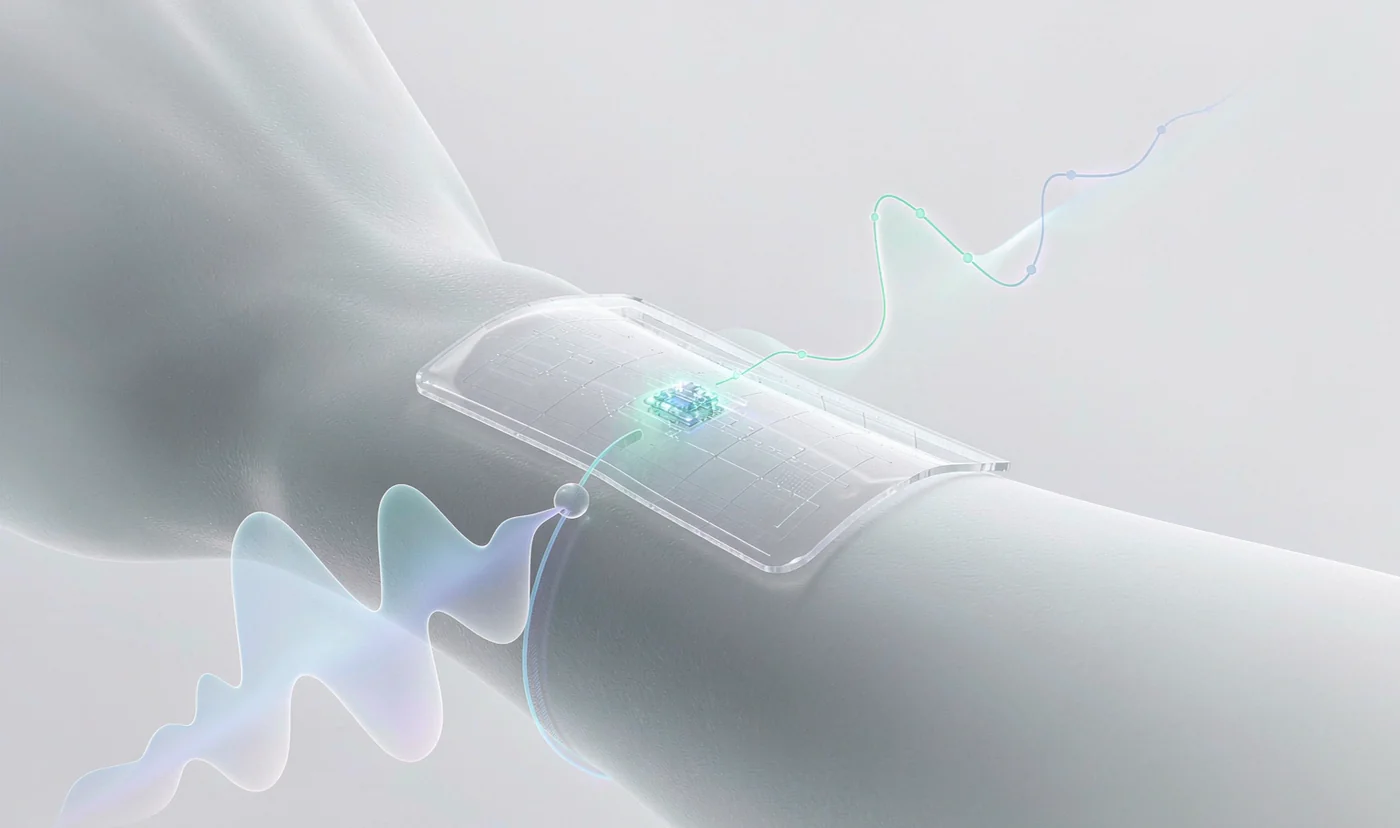
Inside a phone mid-frame, under a laptop palm rest, in a gamepad grip, or along VR/AR headset temples and face-mask edges, lay a 4×4 or 8×8 film array. The housing becomes the contact surface: deformation from a finger press conducts to the array, and the charge ratios across cells reconstruct position, force, distribution and direction — 3D force sensing.
Because the sensor sits inside the housing, no openings or transparent windows are needed externally — inherently scratch-resistant, sealed against water and dust, and it works with gloves on.
Achievable performance
An array distinguishes taps, hard presses, long presses, swipes and pinches; force thresholds enable layered interaction such as "light touch to preview, press to confirm". Output is transient charge with no intrinsic lag, well suited to low-latency scenarios like gamepads. Film under 0.1 mm thick has minimal impact on mechanical stack-up.
The limitation: film outputs change, and sustained static force decays through charge leakage, so it suits event-type interaction rather than constant-force measurement. Continuous force curves need careful charge-amplifier time-constant design, or a hybrid with a piezoresistive layer.
Comparison of technical routes
| Aspect | PVDF array | Capacitive touch | Piezoresistive |
|---|---|---|---|
| Dimensions sensed | Position + force + distribution + direction | Position (2D plane) | Force (single point or sparse array) |
| Surface requirement | Fully hidden inside the structure | Conductive layer; limited by dielectric thickness | Requires an exposed contact surface |
| Gloved use | Yes (force conduction) | No (capacitive coupling fails) | Yes |
| Static force | Poor (charge decay) | — | Good |
| Power | Passive sensing layer | Continuous scanning excitation | Continuous supply |