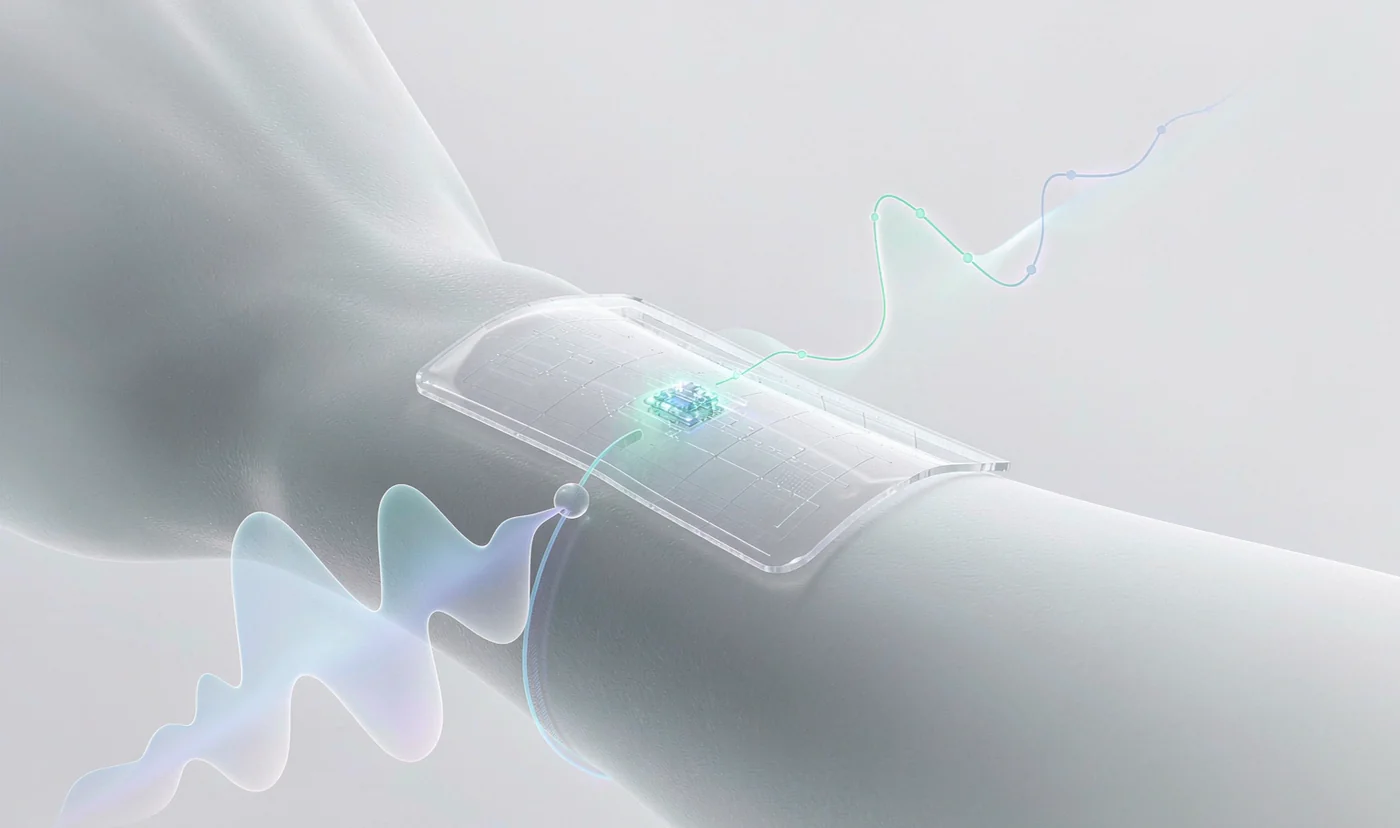
The core engineering conflict in sleep monitoring: the more accurate the device, the closer it must sit to the body — and the closer it sits, the more it disturbs sleep. Piezoelectric film offers a way around it by reframing "human activity" from contact measurement to load measurement.
Deployment scenario
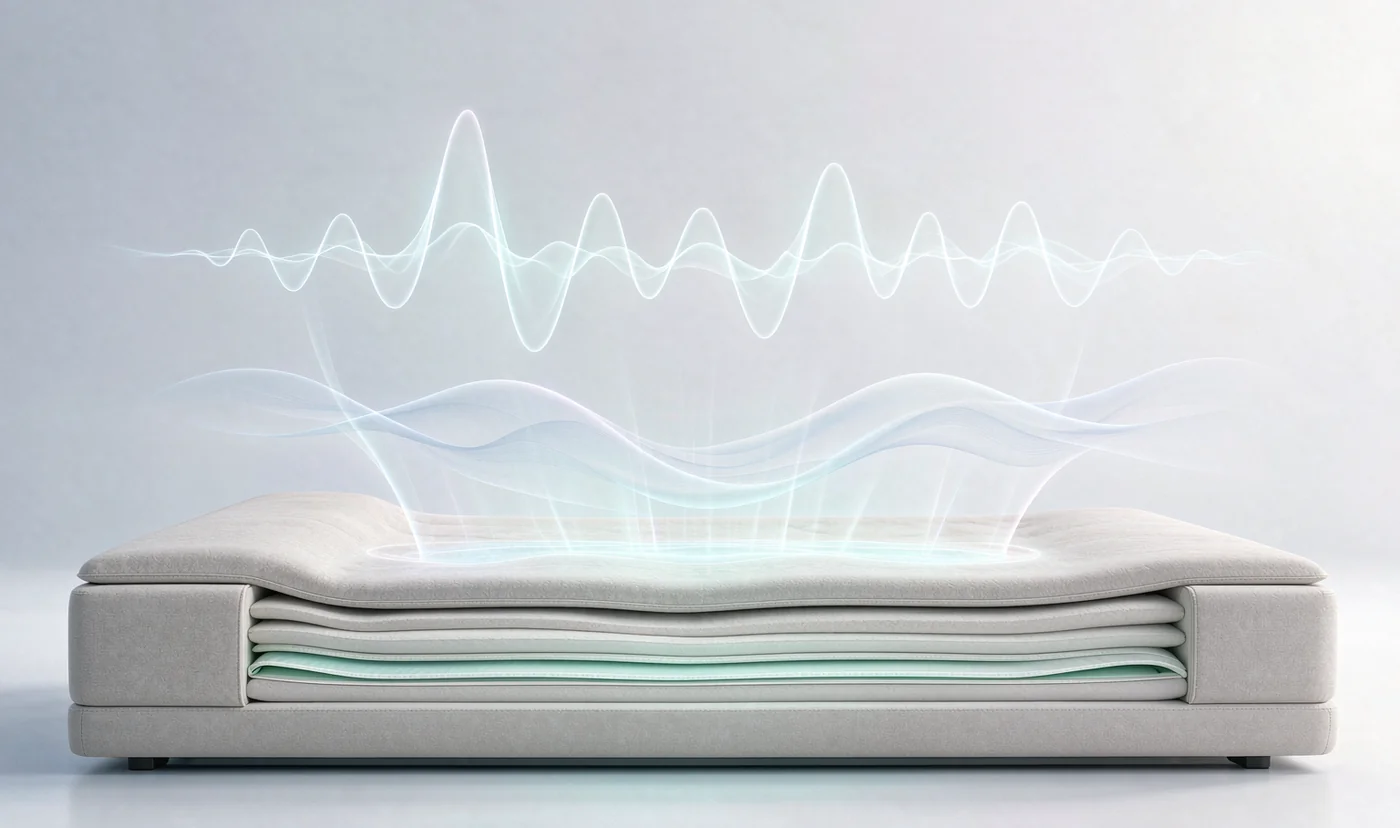
A 300–700 mm film band is laid beneath the mattress surface, parallel to the chest projection, or a 4×4 array covers an area. Chest movement from breathing, micro-vibration from the heartbeat and pressure redistribution from turning are transmitted through the mattress into the film as charge. Signals are conditioned by a bedside charge amplifier and ADC, reduced to features locally, then sent over BLE or Wi-Fi.
Three typical product forms: smart mattresses / mattress toppers (integrated into the bed), smart anti-snore pillows (built into the pillow, linked to height adjustment), and bedside monitoring mats (laid in care facilities without modifying existing beds).
Achievable performance
A combined piezoelectric + piezoresistive band answers two questions at once: is the person in bed (piezoresistive layer, static pressure) and how are breathing and heart rate (piezoelectric layer, dynamic deformation). Respiration rate extraction typically lands within ±1–2 bpm, and resting heart rate within ±3–5 bpm; body movement, bed-exit and turn count are event outputs whose false-alarm rate can be brought into an acceptable engineering range with dual thresholds and time windows.
Note that through-bedding measurement is sensitive to mattress thickness and firmness. Firm mattresses (coir, hard springs) transmit far better than thick latex layers — a site calibration before deployment is recommended.
Comparison of technical routes
| Aspect | PVDF flexible film | Incumbent approach |
|---|---|---|
| Sensing principle | Piezoelectric: direct charge output, passive | Strain gauge / capacitive: continuous power required, baseline drift |
| Mounting | Inside mattress or pillow; works through bedding | Usually needs body contact or direct load |
| Power | Zero static power in the sensing layer | Continuous excitation, an order of magnitude higher |
| Bandwidth | Sub-Hz to hundreds of MHz, covering respiration (0.2–0.5 Hz) and heartbeat (1–1.5 Hz) | Limited by sampling and mechanics; low-frequency drift |
| Comfort | Tens of micrometres thick, conformal, imperceptible | Rigid or thick; long-term discomfort |
| Limitations | No absolute pressure; requires a charge amplifier; pyroelectric interference from temperature change | — |