Industrial prognostics and health management (PHM) comes down to two things: detecting early and distinguishing clearly. Early detection depends on sensitivity and frequency response; clear distinction depends on bandwidth. PVDF is credible on both.
Deployment scenario
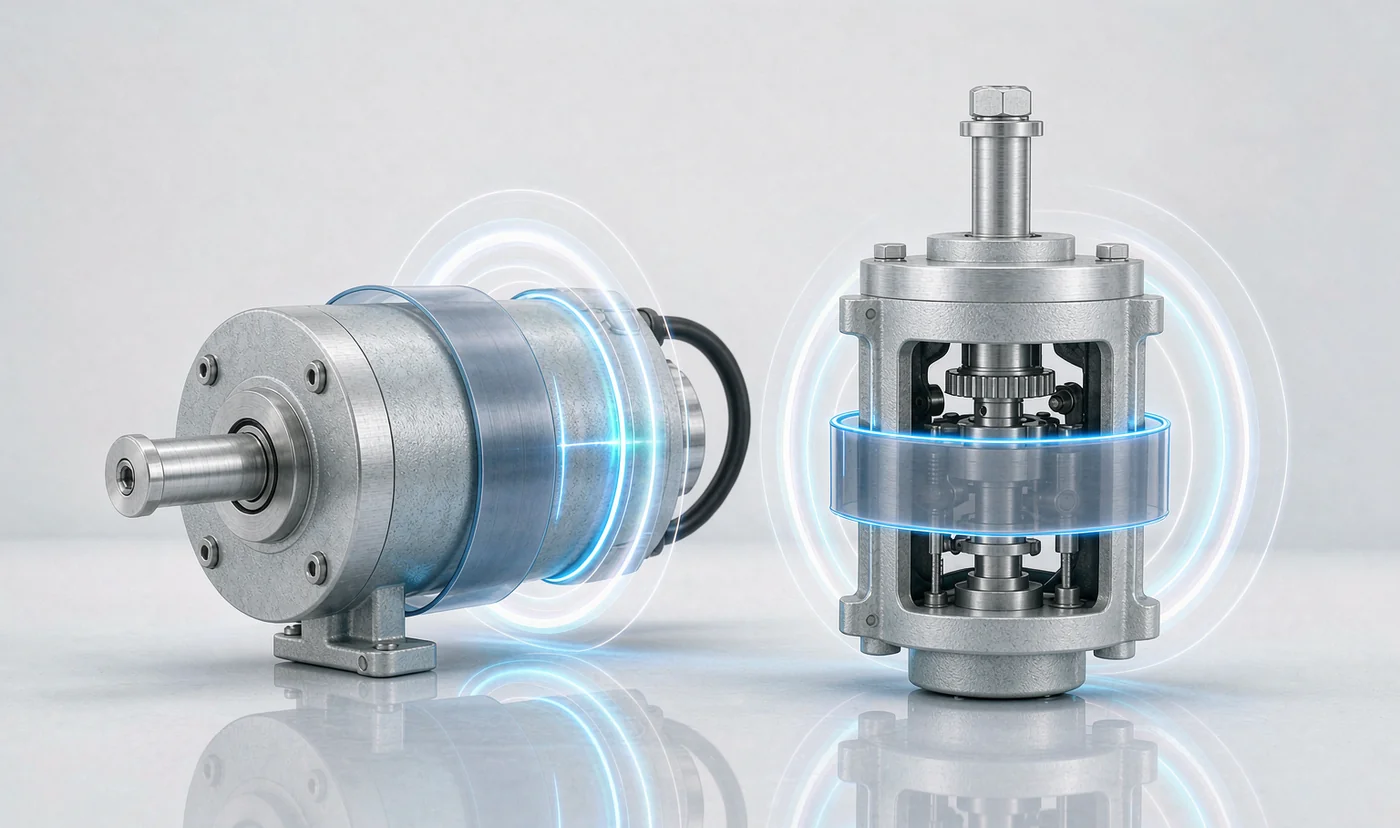
Film sensors are bonded to the housing of motors, pumps, fans, compressors and gearboxes, or integrated into bearing seats, to capture vibration and impact. The film is extremely light, so it barely alters the dynamics of the host structure — a real advantage over ceramic accelerometers, whose mass loading visibly shifts resonance on lightweight structures.
A further approach is large-area coverage: multiple films over a housing form a distributed network that locates the source of anomalous vibration, rather than merely flagging that something is wrong.
Achievable performance
PVDF can cover a broad frequency range, allowing one sensing architecture to observe low-frequency structural vibration alongside higher-frequency bearing-defect impacts and gear-meshing features. In practice the spectrum is split into three bands: low frequency for imbalance and looseness, mid frequency for gear meshing, and high frequency for early bearing pitting and cracks. The actual response limits depend on film thickness, electrode geometry, encapsulation and mounting interface, together with the front-end circuit, filtering and sampling rate, and should be confirmed by a measured frequency-response curve.
Limitations stated plainly: the charge output is weak and needs a low-noise charge amplifier nearby — long cables seriously degrade signal-to-noise ratio. The film is also temperature sensitive; harsh thermal cycling requires compensation or a compensated structure.
Comparison of technical routes
| Aspect | PVDF film | IEPE ceramic accelerometer | MEMS accelerometer |
|---|---|---|---|
| Mass loading | Negligible; structure dynamics unchanged | Significant; shifts resonance on light structures | Small |
| Frequency response | Sub-Hz to hundreds of MHz | ≈ 0.5 Hz to 10 kHz typical | ≈ 0 to a few kHz |
| Mounting | Adhesive bonding, no drilling | Threaded or magnetic mount, flat surface required | Requires PCB fixing |
| Curved surfaces | Conforms to pipes and arcs | Limited | Limited |
| Power | Passive (external charge amp) | IEPE constant-current supply | Requires supply |
| Limitations | Weak signal, local amplification needed; temperature sensitive | Mass loading; impact-fragile | Higher noise floor; insufficient at high frequency |