The cost of a pipeline leak is never just the lost medium. Oil and gas leaks risk fire and explosion; district-heating leaks mean continuous thermal loss; compressed-air leaks are a chronically ignored electricity bill. Acoustic emission (AE) is the industry-recognised method for early detection.
Principle and deployment
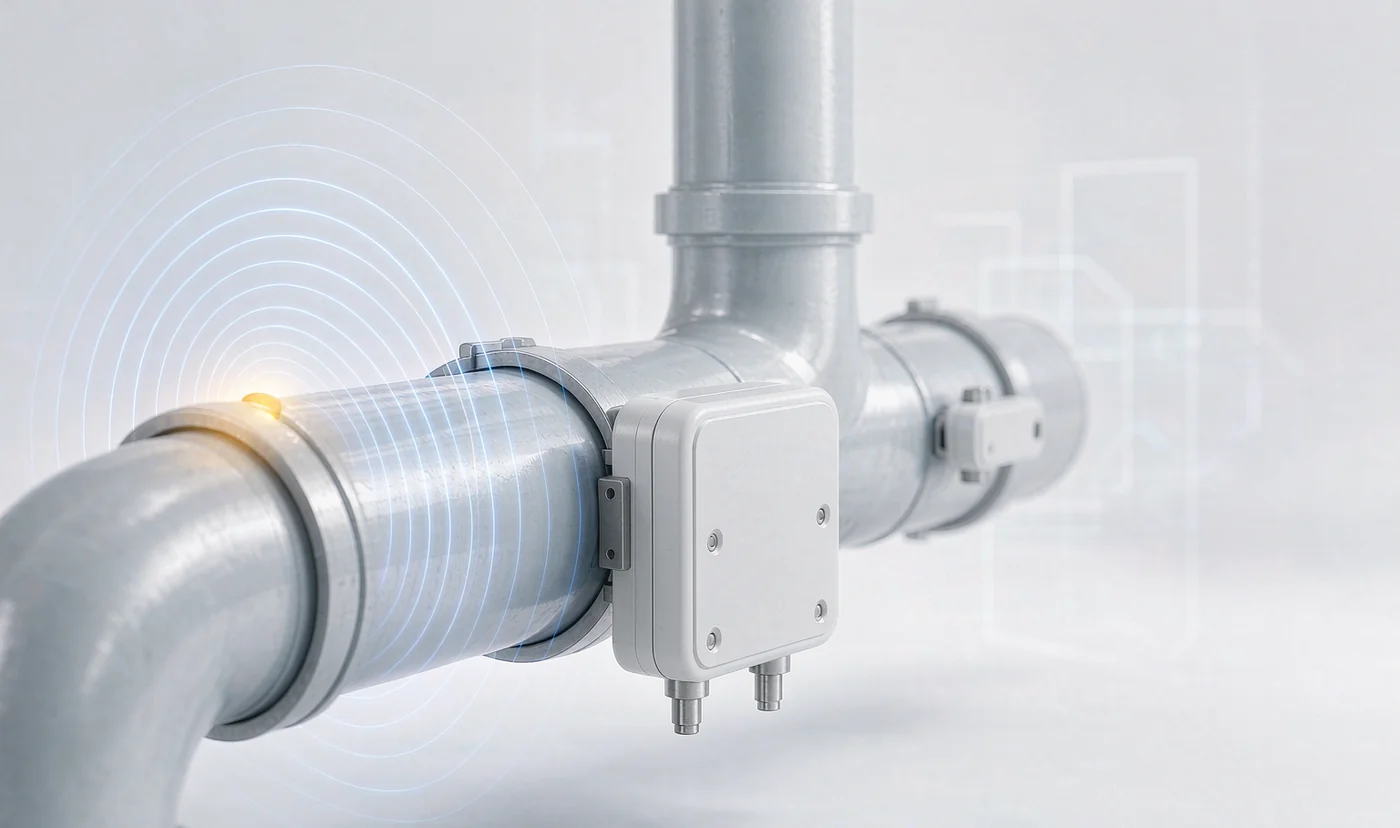
Fluid escaping at high velocity through a breach generates broadband acoustic waves (typically 1–100 kHz) that propagate as elastic waves along the pipe wall. A piezoelectric sensor array at intervals on the outer wall captures them; time difference of arrival (TDOA) locates the leak, while signal energy and spectral features indicate severity.
Typical scenarios: online monitoring of long-distance oil and gas pipelines; micro-leak detection on reactor connection piping in chemical plants; heat-loss surveys on district-heating networks; compressed-air energy audits.
Achievable performance and engineering difficulties
Acoustic emission is passive — nothing is injected into the pipe — so it runs continuously during production without affecting the process. Wavelet transforms, short-time Fourier analysis and blind source separation are commonly used to suppress pump, valve and flow noise.
Three sources of difficulty: background noise is severe, making signal-to-noise a permanent challenge; plastic and composite pipes attenuate sound strongly, sharply reducing detection range; and location accuracy is limited by sensor spacing. Practice therefore fuses acoustic emission with mass balance and pressure-gradient methods to cut false alarms.
Comparison of technical routes
| Aspect | Acoustic emission (piezo) | Mass balance (CPM) | Distributed acoustic sensing (DAS) | Inspection robot |
|---|---|---|---|---|
| Mode | Online, passive, non-intrusive | Online, model-based | Online, distributed and continuous | Offline, segment by segment |
| Sensitivity | High — micro-leaks detectable | Low — small leaks missed | High | Depends on travel speed |
| Locating | Yes (TDOA) | Section estimate | Precise | Precise |
| Cost | Moderate | Low | High | Moderate |
| Main limitation | Background noise; high attenuation in non-metallic pipe | Cannot detect small leaks | High cost and complex installation | Not continuous |